Written and medically reviewed by Dr Gaurav Bedi, BDS, MDS (Periodontics and Implantology), Principal Dentist, Ryde Dental Family, Ryde NSW. Last reviewed: 7 October 2026.
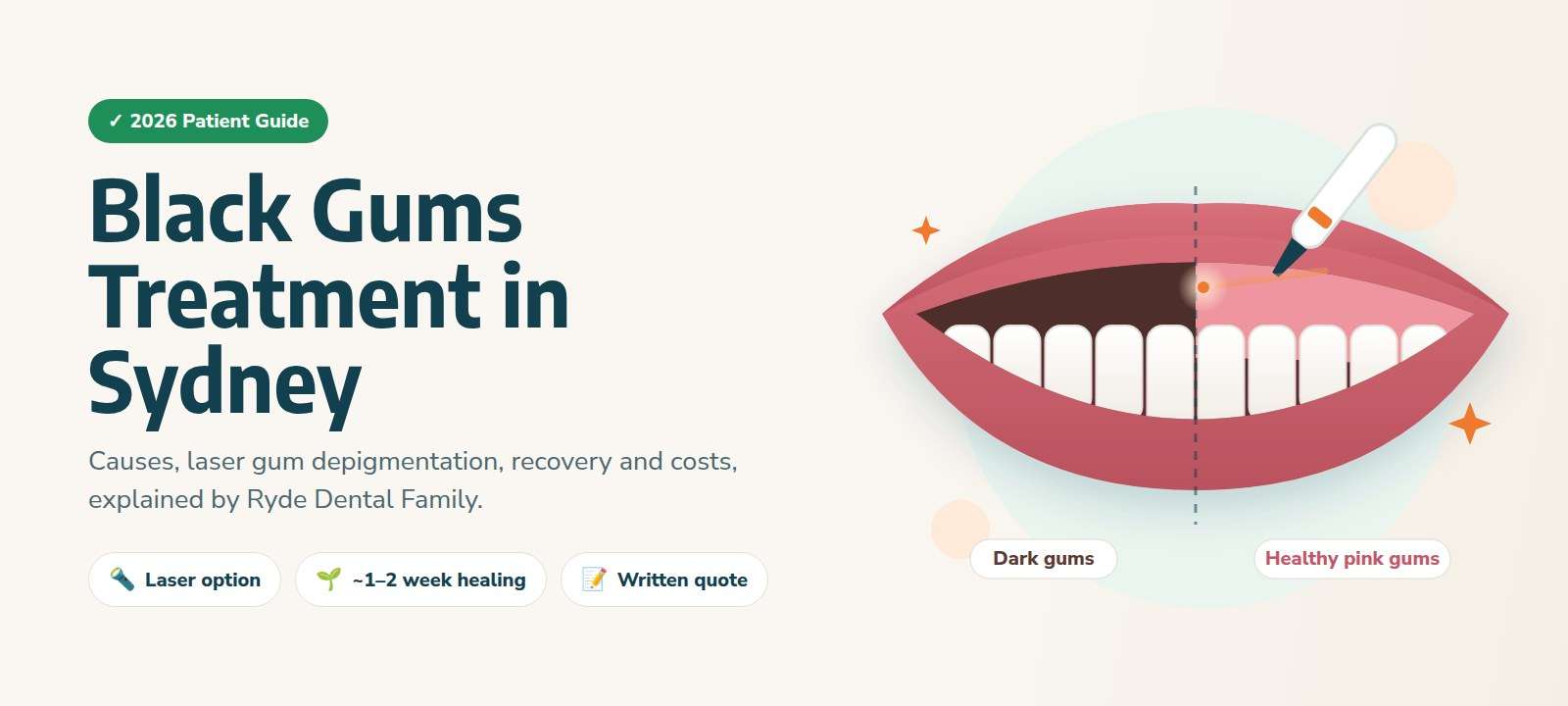
Dark or black gums are usually harmless, but they can make people self-conscious about smiling. At Ryde Dental Family in Top Ryde, we treat black gums with gum depigmentation, a minor procedure that removes excess pigment so lighter, pink tissue can heal in its place. This guide explains what causes black gums, which treatments work, what recovery is like and what treatment costs in Sydney.
Quick answer: The main treatment for black gums is gum depigmentation, done with a dental laser or a scalpel. Both remove the thin pigmented surface layer of the gum. A review of 25 studies found laser and scalpel give similar colour results, but laser patients report less pain after treatment [2]. Pigment can slowly return over months to years, and sooner in smokers [4].
In this guide:
The basics
What are black gums?
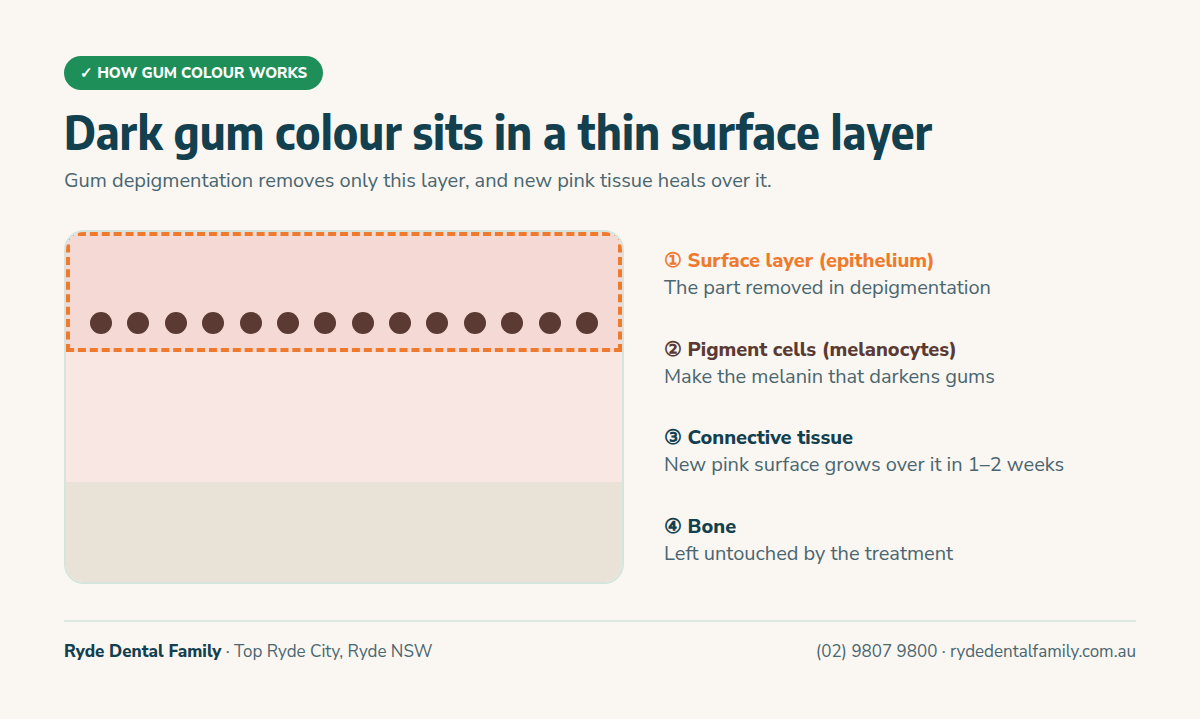
Black gums are gums with extra melanin, the same pigment that colours skin and hair. Melanin is made by cells called melanocytes, which sit in the bottom layer of the gum's thin surface skin (the epithelium) [1]. Dentists call this gingival hyperpigmentation or gingival melanosis.
Healthy gum colour ranges from pale coral pink to deep brown, and melanin is the most common reason gums look dark [1]. When the colour is even, on both sides, and has been there for years, it is usually physiologic pigmentation: normal for that person, not a disease [3]. It is more common in people with naturally darker skin, but it can appear in anyone [1].
Causes
What causes black gums?
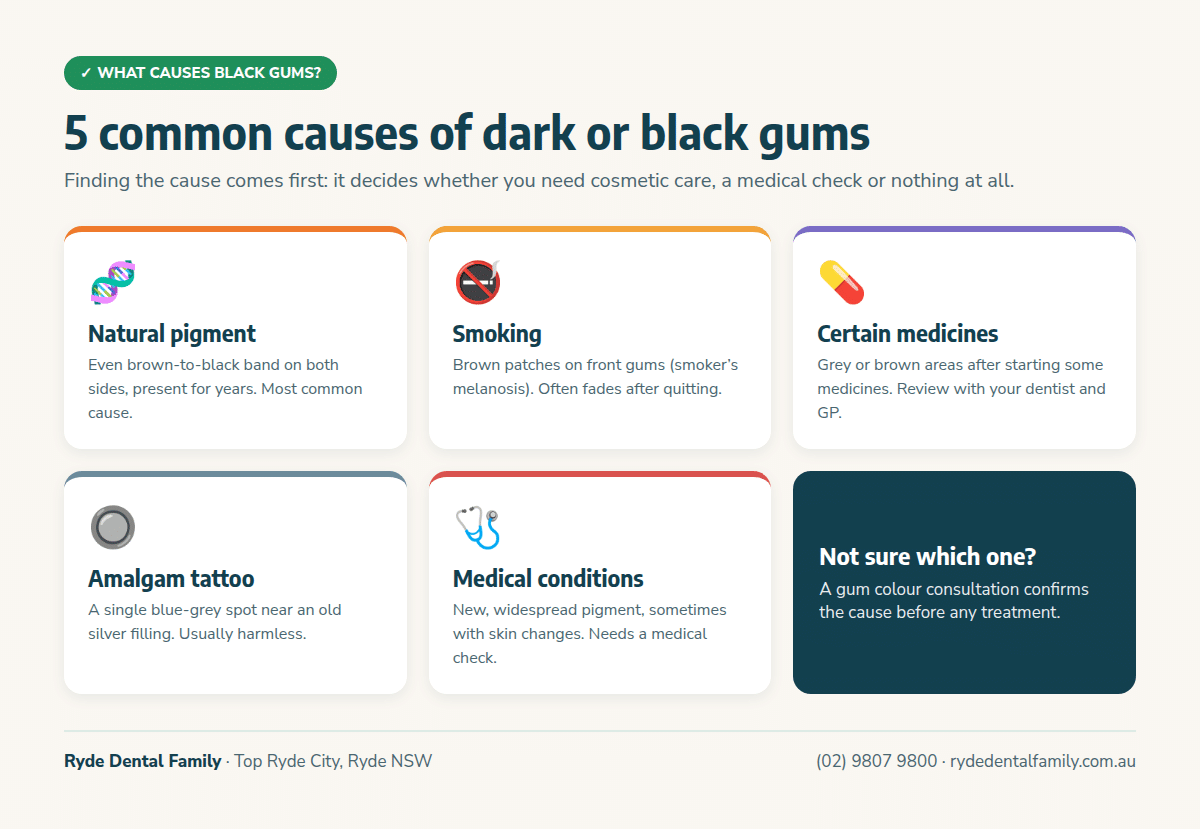
Most black gums are simply inherited pigment, but smoking, some medicines and a few medical conditions can also darken gums [3]. Finding the cause comes first, because it decides whether you need cosmetic treatment, a medical check or nothing at all.
| Cause | What it usually looks like | What helps |
|---|---|---|
| Natural (physiologic) pigment | An even brown-to-black band on both sides, present for years [3] | Gum depigmentation if the colour bothers you |
| Smoking (smoker's melanosis) | Brown patches, most often on the front gums [1] | Quitting; the pigment often fades over months to years [5] |
| Certain medicines (for example some antimalarials and the antibiotic minocycline) | Grey, blue-grey or brown areas that appear after starting the medicine [3] | A review with your dentist and GP. Never stop a medicine on your own |
| Amalgam tattoo | A single blue-grey or black spot near an old silver filling or extraction site [3] | Usually harmless; an X-ray or biopsy if there is any doubt |
| Medical conditions (for example Addison's disease) | New, widespread brown pigment, sometimes with skin changes [3] | A medical check-up to find and treat the cause |
Smoking deserves special mention. Nicotine binds to melanin and stimulates pigment cells, so smokers often develop darker front gums even if they have fair skin [1]. If you smoke and want lighter gums, quitting is the first step. Free help is available from Quitline on 13 7848.
Safety first
When should dark gums be checked?
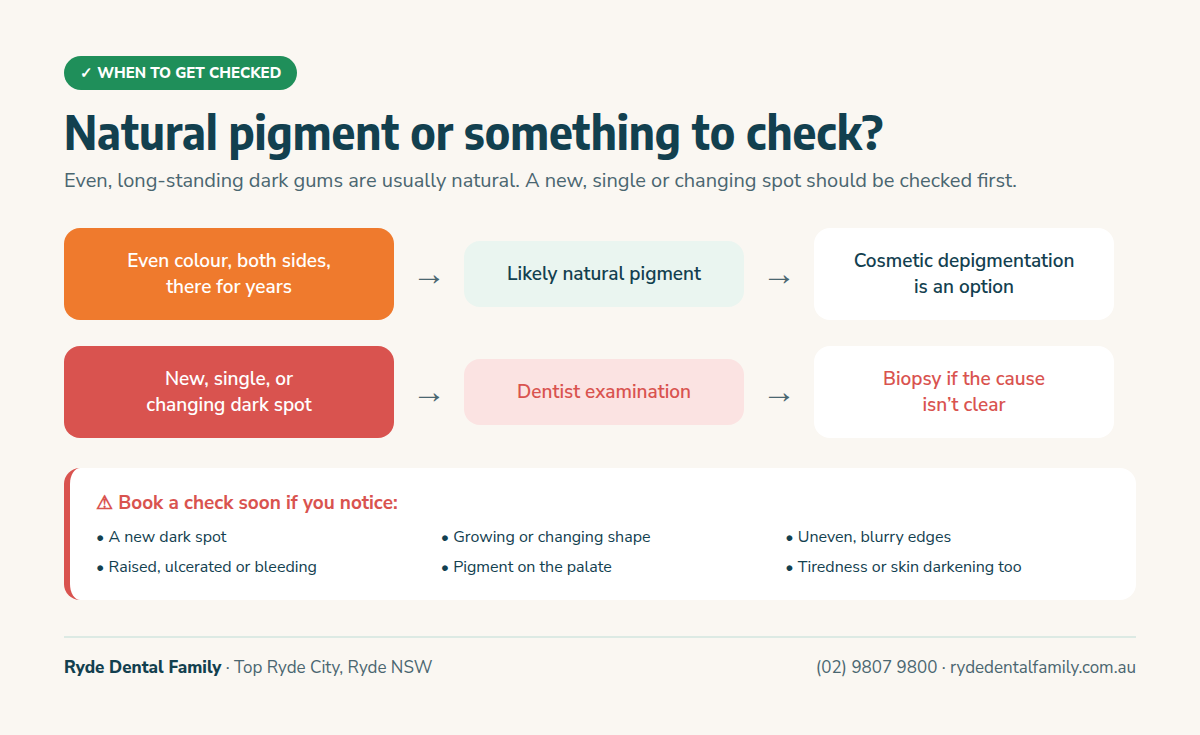
Even, long-standing pigment is rarely a worry, but a single dark spot that is new or changing should always be examined. Oral melanoma is rare, yet early pigmented lesions can look harmless, so dentists take a biopsy whenever the cause cannot be confirmed by looking [3].
Book a check soon if you notice any of these:
- A new dark spot, especially a single one
- A spot that grows, darkens or changes shape
- Uneven or blurry edges
- A raised, ulcerated or bleeding area
- Pigment on the roof of the mouth
- New pigment together with tiredness, weight loss or skin darkening
Before any cosmetic gum treatment, Dr Bedi confirms the pigment is benign. Depigmentation is only offered once a medical cause has been ruled out.
Treatment options
Black gums treatment options
Gum depigmentation removes the thin pigmented surface layer of the gum so new, lighter tissue can heal over it. Laser and scalpel are the two best-studied ways to do this; the others are used less often [1].
| Method | How it works | Comfort and healing | Things to know |
|---|---|---|---|
| Laser depigmentation (diode, Er:YAG, CO2 or Nd:YAG) | Laser light removes the pigmented cells layer by layer | Less bleeding and less pain than scalpel in most trials [1][2] | Usually needs only numbing gel or a small injection; laser type affects how long results last [4] |
| Scalpel (surgical stripping) | The dentist gently shaves off the pigmented layer | More bleeding and discomfort; a gum dressing and 7 to 14 days of healing [1] | Long track record and low equipment cost [1] |
| Cryosurgery | Freezes the pigmented tissue | Healing in about 3 to 4 weeks in published reports [1] | Used less often |
| Electrosurgery | An electrical current removes tissue | Risk of heat damage to bone underneath if not tightly controlled [1] | Rarely a first choice |
| Free gum graft | Covers the area with tissue taken from the palate | Two healing sites | Colour may not match the surrounding gum [1] |
Laser or scalpel: what does the research say?
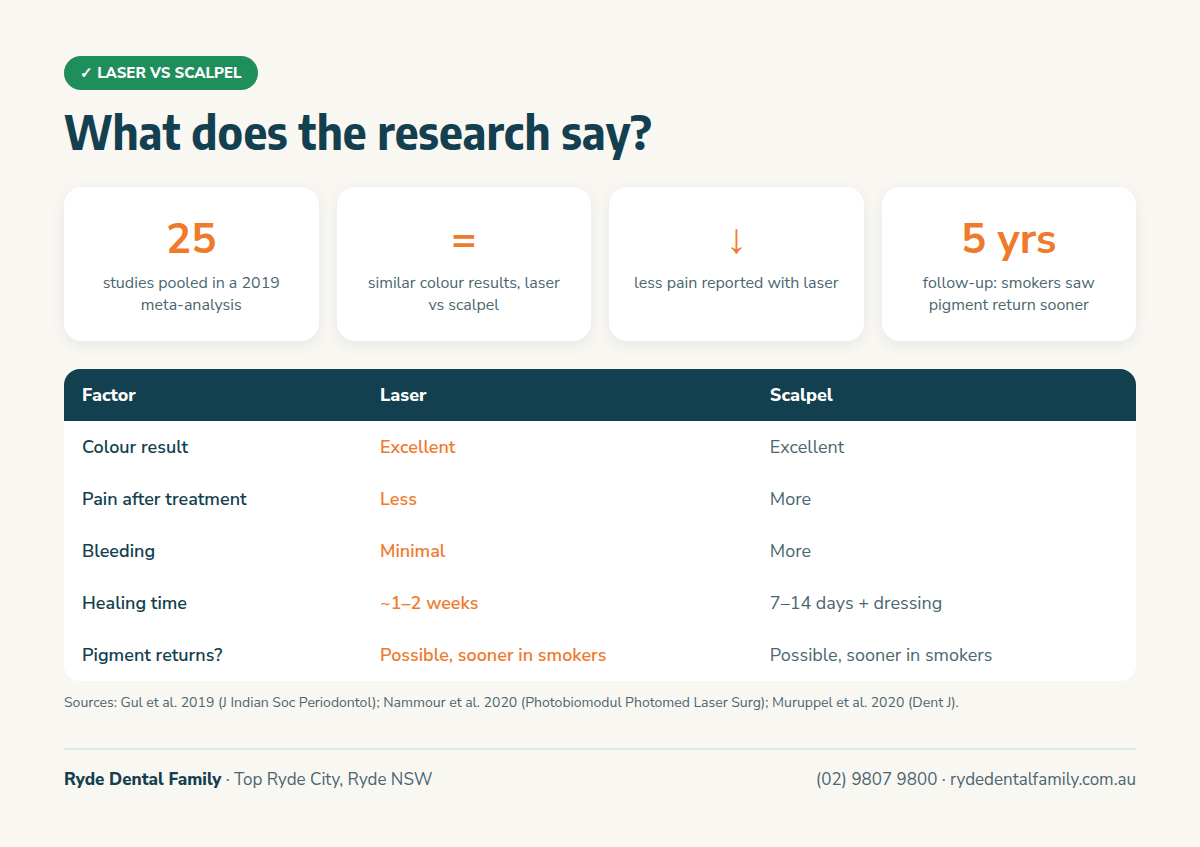
A 2019 systematic review and meta-analysis pooled 25 studies comparing other methods with scalpel stripping. Laser and scalpel removed pigment equally well, and pigment came back at similar rates, but laser patients reported significantly less pain [2]. A separate systematic review agreed that no single laser has been proven best, because trials use different methods [1].
How long results last depends on the laser and on smoking. In a randomised study of 72 people followed for up to five years, the diode laser kept gums clear the longest and the Er:YAG laser the shortest. Smokers saw pigment return sooner with every laser [4].
Non-surgical options, such as vitamin C injections into the gum, are being studied but are not yet standard care [6].
Learn more about how we use lasers on our Laser Dentistry page.
Your visit
What to expect, step by step
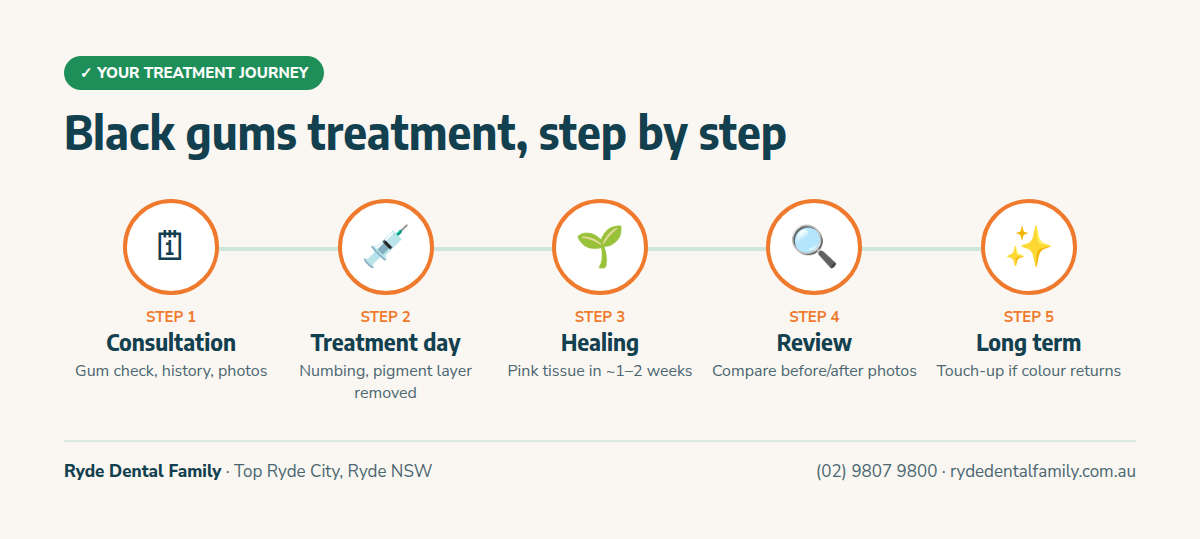
Most patients have each arch (upper or lower front gums) treated in one visit, then heal over about one to two weeks [1]. Here is how it usually runs at our Ryde clinic.
- Consultation. We look at your gums, smile line and medical history, ask about smoking and medicines, and take photos to compare later. Any gum inflammation is treated first so healing is predictable.
- Treatment day. The area is numbed with gel or a small injection. The pigmented layer is removed from the gums that show when you smile. Some people need a short touch-up session for small leftover spots [1].
- The first one to two weeks. The treated gum looks white or light brown at first and feels tender, then turns pink as new tissue grows [1]. Choose soft, cool foods, brush gently and avoid smoking.
- Review visit. We check healing and compare your new photos with the originals.
- Long term. Pigment can slowly return as pigment cells move back in from nearby gum. In one report, colour began to return after 32 months and was complete after seven years [1]. A light touch-up can be repeated if needed.
Fees and health funds
How much does black gums treatment cost in Sydney?
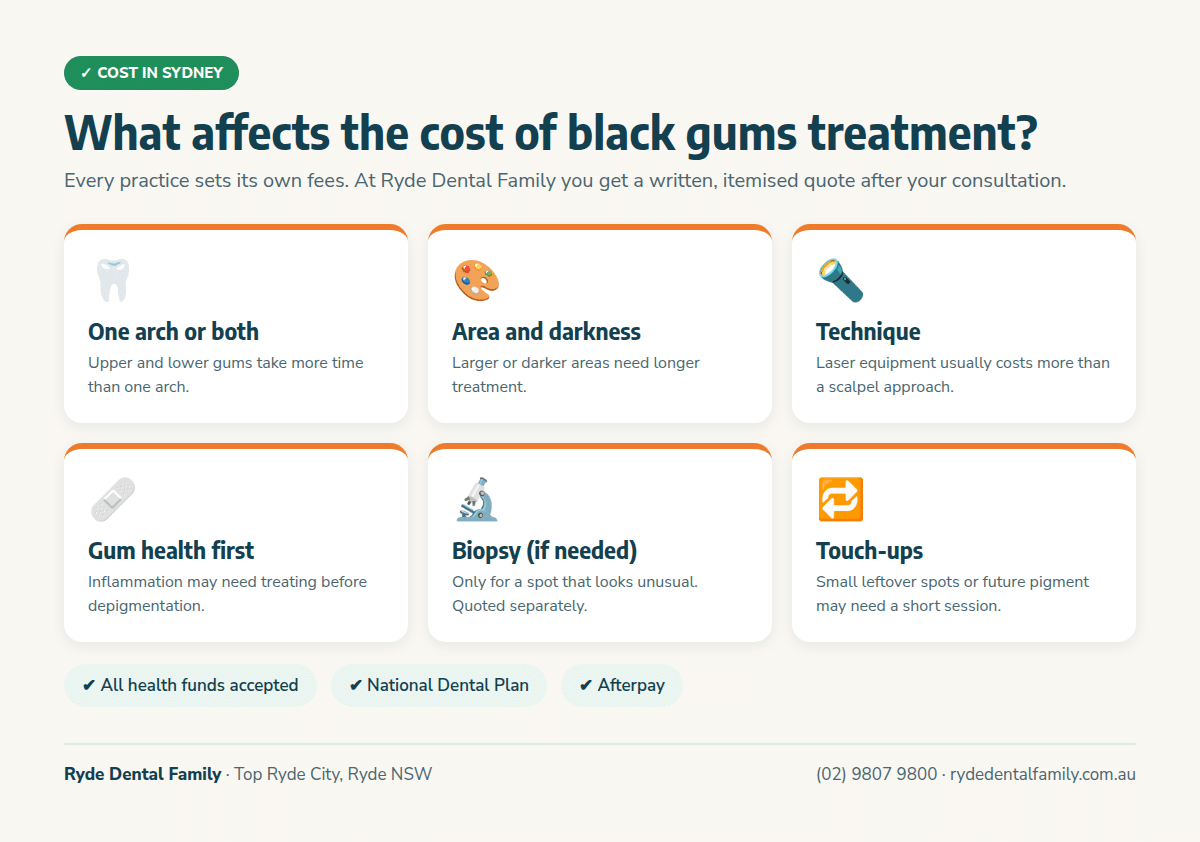
There is no set fee for gum depigmentation in Australia, because each practice sets its own prices. Your cost depends mostly on how many arches are treated and which technique suits your gums. At Ryde Dental Family, you receive a written, itemised quote after your consultation, before any treatment starts.
| What affects the price | Why it matters |
|---|---|
| One arch or both | Treating upper and lower gums takes more time than one arch |
| How wide and dark the pigment is | Larger or darker areas need longer treatment |
| Technique | Laser equipment usually costs more than a scalpel approach |
| Gum health first | Gum inflammation may need treating before depigmentation |
| Biopsy | Only needed if a spot looks unusual; quoted separately |
| Touch-ups | Small leftover spots or future return of pigment may need a short extra session |
Health funds, Medicare and payment plans
Because depigmentation is usually cosmetic, many extras policies pay little or nothing towards it. Ask your fund what it pays using the item numbers on your quote. Medicare generally does not cover cosmetic dental treatment for adults.
Ryde Dental Family accepts all health funds and offers payment options, including National Dental Plan and Afterpay, to spread the cost.
Visit us in Ryde
Black gums treatment in Ryde, Sydney
Ryde Dental Family is inside Top Ryde City Shopping Centre, so you can combine your appointment with errands, with centre parking and regular buses close by. We see patients from across Sydney's north-west and inner west.
| Address | Shop 2035, Level LG1, Top Ryde City Shopping Centre, Ryde NSW 2112 |
| Phone | (02) 9807 9800 |
| Opening hours | Monday to Saturday 9am–5pm, after-hours appointments on Thursdays |
| Nearby suburbs | Ryde, Top Ryde, West Ryde, Meadowbank, Putney, Gladesville, Eastwood, Denistone, North Ryde, Macquarie Park, Marsfield, Epping and Hunters Hill |
Why patients choose us for gum treatment:
- Gum-focused care. Dr Gaurav Bedi holds a Master of Dental Surgery in Periodontics and Implantology, the area of dentistry that deals with gums.
- Laser dentistry in-house. We use laser for gum and soft-tissue procedures, which typically means less bleeding and a gentler recovery.
- Saturday appointments for people who work weekdays.
- All health funds accepted, with payment plans available.
Myth vs fact
Myth vs fact
| Myth | Fact |
|---|---|
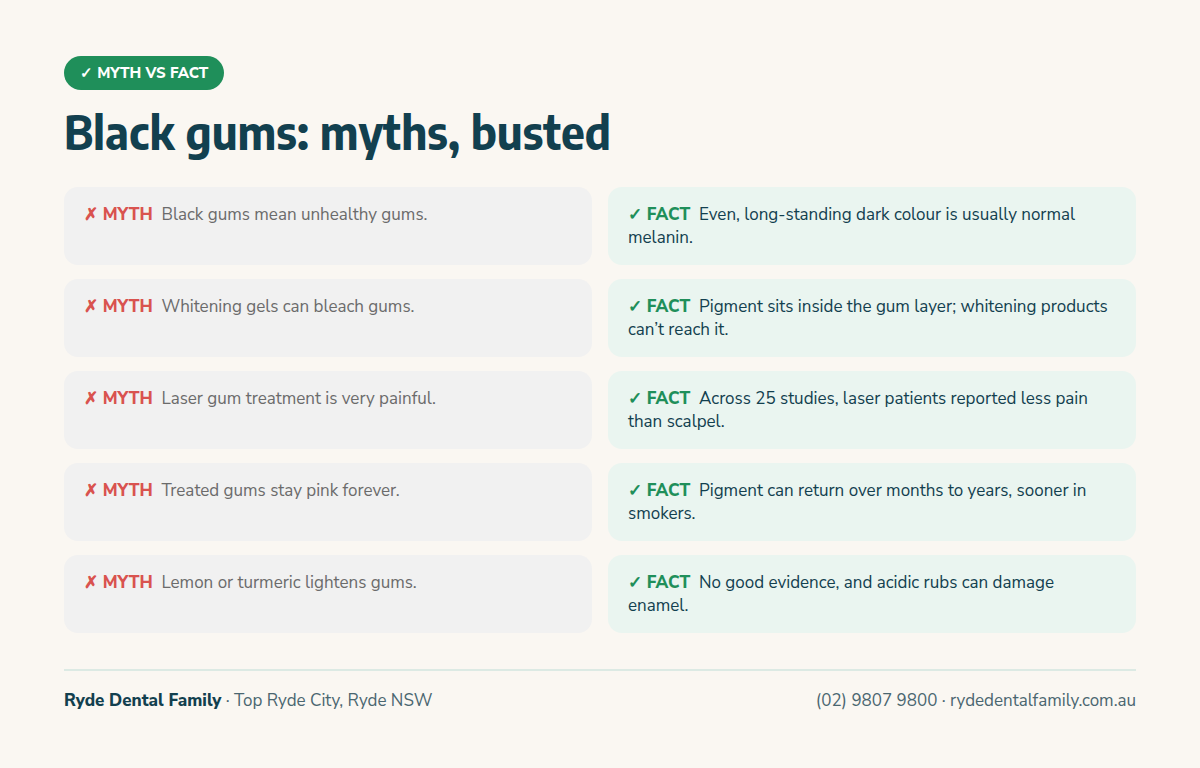
| Black gums mean your gums are unhealthy. | Even, long-standing dark colour is usually normal melanin. Healthy gums can be dark [3]. |
| Whitening toothpaste or gels can bleach dark gums. | The pigment sits inside the gum's surface layer, so tooth-whitening products cannot reach it [1]. Peroxide gels can also irritate gums. |
| Laser gum treatment is very painful. | Across 25 studies, laser patients reported significantly less pain than scalpel patients [2]. |
| Once treated, gums stay pink forever. | Pigment can return over months to years, and sooner in smokers [1][4]. A touch-up can be repeated. |
| Every dark spot is harmless. | A single new or changing spot needs checking, and sometimes a biopsy [3]. |
| Home remedies like lemon or turmeric lighten gums. | There is no good evidence for home remedies, and acidic rubs can damage tooth enamel. |
FAQs
Frequently asked questions
Are black gums normal?
Usually, yes. Even, long-standing dark colour on both sides is most often natural melanin and not a disease [3]. A single new or changing spot is different and should be checked.
Is black gums treatment permanent?
Results are long-lasting but not guaranteed to be permanent. Pigment can return over months to years as pigment cells move back in, and it tends to return sooner in smokers [1][4].
Does laser gum depigmentation hurt?
The area is numbed first, and most people feel mild tenderness afterwards. Studies show laser patients report less pain than scalpel patients [2].
How long does it take to heal?
Most people heal in about one to two weeks [1]. The gum looks white or light brown at first, then turns pink as new tissue grows.
Will quitting smoking lighten my gums?
Often, yes. Smoker's melanosis has been shown to fade after people cut down or stop smoking, although it can take months or longer [5]. Quitting also helps depigmentation results last longer [4].
How much does black gums treatment cost in Sydney?
Fees vary between practices and depend on how many arches are treated, the technique and your gum health. At Ryde Dental Family, you get a written quote after your consultation.
Does private health insurance cover gum depigmentation?
Sometimes, in part. Because it is usually cosmetic, many extras policies pay little. Check with your fund using the item numbers on your quote.
Where can I get black gums treatment near me in Ryde?
Ryde Dental Family offers black gums assessment and treatment at Shop 2035, Level LG1, Top Ryde City Shopping Centre, Ryde NSW 2112. Call (02) 9807 9800 to book.
Book your black gums consultation in Ryde
If dark gums are holding back your smile, start with a gum colour consultation. Dr Bedi will check the cause, explain whether laser or another method suits you, and give you a written quote.
Ryde Dental Family · Shop 2035, Level LG1, Top Ryde City Shopping Centre, Ryde NSW 2112 · Monday to Saturday 9am–5pm, after-hours appointments on Thursdays
References
- Muruppel AM, Pai BSJ, Bhat S, Parker S, Lynch E. Laser-assisted depigmentation: an introspection of the science, techniques, and perceptions. Dent J (Basel). 2020;8(3):88. PMID: 32781667.
- Gul M, Hameed MH, Nazeer MR, Ghafoor R, Khan FR. Most effective method for the management of physiologic gingival hyperpigmentation: a systematic review and meta-analysis. J Indian Soc Periodontol. 2019;23(3):203–215. PMID: 31143000.
- Rosebush MS, Briody AN, Cordell KG. Black and brown: non-neoplastic pigmentation of the oral mucosa. Head Neck Pathol. 2019;13(1):47–55. PMCID: PMC6405786.
- Nammour S, El Mobadder M, Namour M, et al. A randomized comparative clinical study to evaluate the longevity of esthetic results of gingival melanin depigmentation treatment using different laser wavelengths (diode, CO2, and Er:YAG). Photobiomodul Photomed Laser Surg. 2020;38(3):167–173.
- Hedin CA, Pindborg JJ, Axell T. Disappearance of smoker's melanosis after reducing smoking. J Oral Pathol Med. 1993;22(5):228–230. PMID: 8315602.
- Esmat SA, El-Sayed NM, Fahmy RA. Vitamin C mesotherapy versus diode laser for the esthetic management of physiologic gingival hyperpigmentation: a randomized clinical trial. BMC Oral Health. 2023;23(1):899. PMID: 37990224.
Disclaimer
This article is for general education only and is not a diagnosis or treatment advice for any individual. Gum colour changes can have medical causes, so please see your dentist or doctor for a personal assessment before choosing any treatment. Any surgical or invasive procedure carries risks; before proceeding, you should seek a second opinion from an appropriately qualified health practitioner.